Analytics Product · Decision Support
RunLab
Analytics tools for better training and racing decisions.
An independent analytics product exploring how running-performance methodology can be translated into practical pacing, equivalence and training decision-support tools.
Explore RunLab →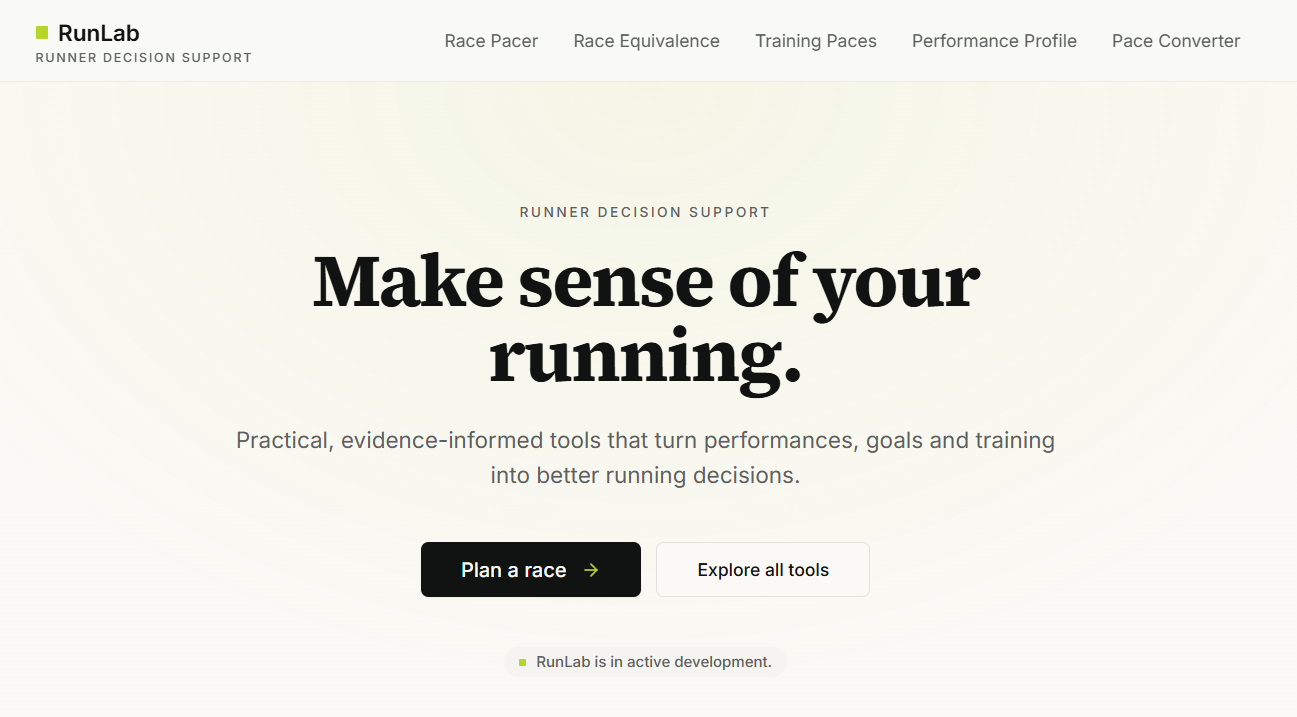
From performance data to practical decisions
Running produces plenty of data. The harder problem is turning established performance methodology into useful decisions about pacing, equivalent performances and training intensity.
RunLab explores how analytical models can become simple, practical tools rather than remaining abstract calculations.
Current tools
Race pacing
Track Race Pacer
800m · 1500m · 3000m
Supports Optimal and Even pacing approaches.
Road Race Pacer
5K · 10K · Half Marathon · Marathon
Performance modelling
Race Equivalence
Compare equivalent performances across race distances.
Pace Converter
Convert running pace between common units.
Training decision support
Training Paces
Translate performance into practical training intensity guidance.
Training Principles
Explain how different training intensities fit together.
Race pacing
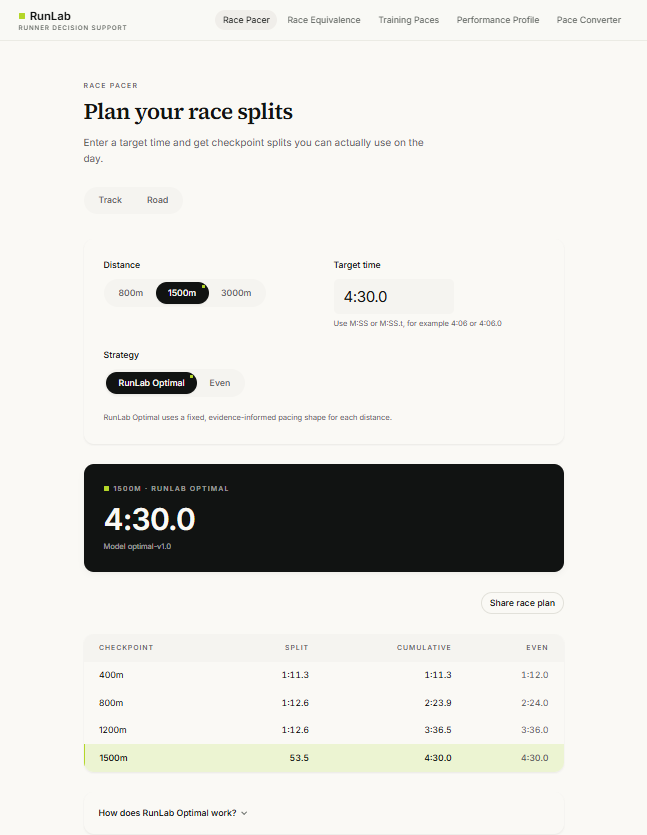
Translating a race target into checkpoint splits that can actually be used on the day.
Analytics as a product, not just an output
RunLab is an exercise in turning methodology into repeatable tools — designed around the decision someone is trying to make, not around displaying every available number.
The work sits in converting analytical models into understandable outputs, holding enough methodological rigour to be trustworthy, and iterating the product based on real use rather than assuming the first version is the right one.
Optimal versus even pacing
Should a race-pacing tool simply return perfectly even splits, or should recommended pacing vary by race distance?
RunLab supports Optimal — evidence-informed pacing designed to reflect the selected event — and Even — constant pace throughout, as a simple reference.
Do not assume that the same pacing profile is optimal for 800m, 1500m, 3000m and road races.
Potential personalised pacing based on athlete characteristics and previous performances.
Future / experimental
Performance equivalence
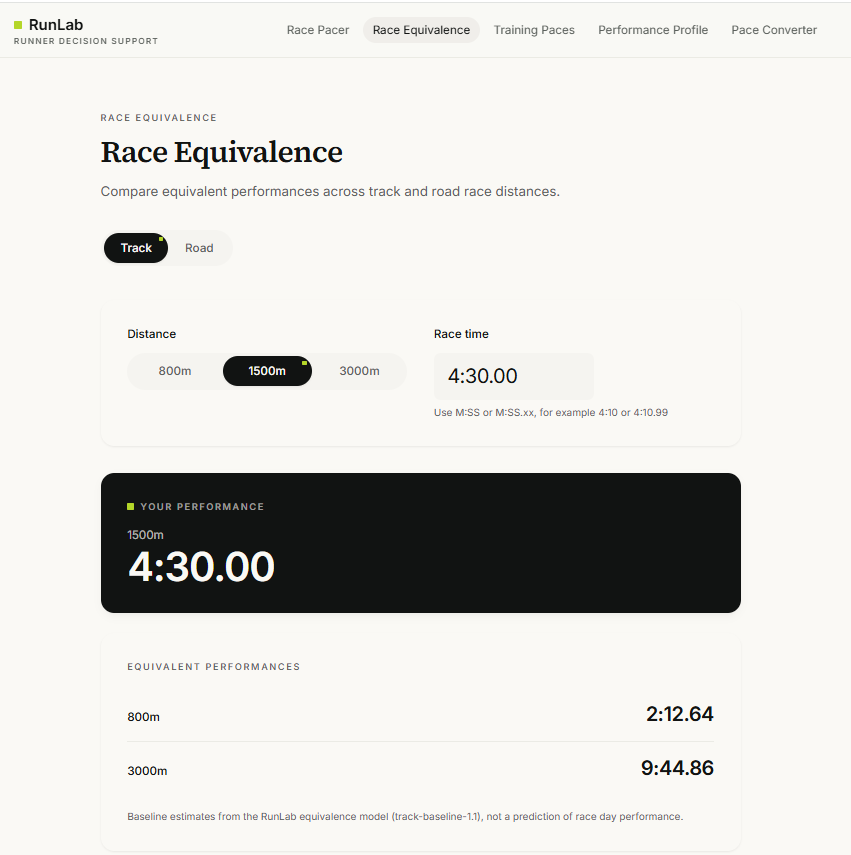
RunLab currently uses a configurable race-equivalence model. The baseline is Riegel 1.06 — a transparent starting point for estimating equivalent performances across distances, not a universally correct physiological model.
The architecture is intended to allow future refinement and personalised profiling, rather than locking the product to a single formula.
Towards more personalised analytics
Future exploration may classify athletes approximately as speed-oriented, balanced or endurance-oriented, using multiple performances rather than assuming one equivalence model fits everyone equally well.
Future product direction — not a completed personalised model
AI-assisted product development
AI-assisted development is used to accelerate research, prototyping, implementation and iteration. Analytical assumptions, methodology, UX decisions and acceptance remain human decisions.
What the project demonstrates
Analytics product thinking
Turning analytical methodology into repeatable tools.
Analytical modelling
Pacing, race equivalence and training-intensity logic.
Decision-support UX
Presenting analytical outputs in ways that support practical choices.
Experimentation
Testing alternative models and product behaviours.
AI-assisted delivery
Using modern development workflows to accelerate iteration.